PVC Casing Pipe Manufacturers India: Preventing Borewell Pipe Cracks and Collapse
Borewell casing failure can lead to serious problems: cracked pipes, soil entering the well, reduced water flow, damaged pumping equipment, and expensive repairs. For this reason, selecting reliable PVC casing pipe manufacturers India is not simply a matter of comparing pipe prices. The material, dimensions, mechanical properties, joint design, installation method, and suitability for the well depth all affect long-term performance.
PVC-U casing pipes are specifically designed for bore and tubewells, and IS 12818:2010 covers PVC-U screen and casing pipes for these applications. This guide explains why borewell casing pipes crack or collapse, what to check before purchasing, and how manufacturers, engineers, contractors, dealers, and homeowners can reduce installation and service failures.
What Is a PVC Borewell Casing Pipe?
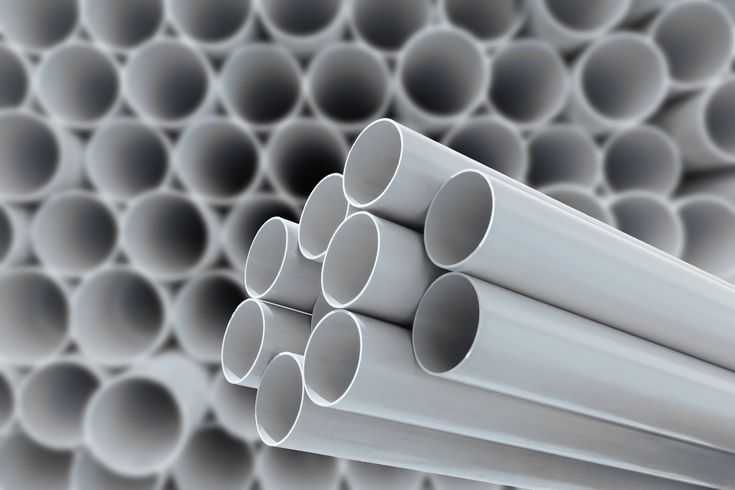
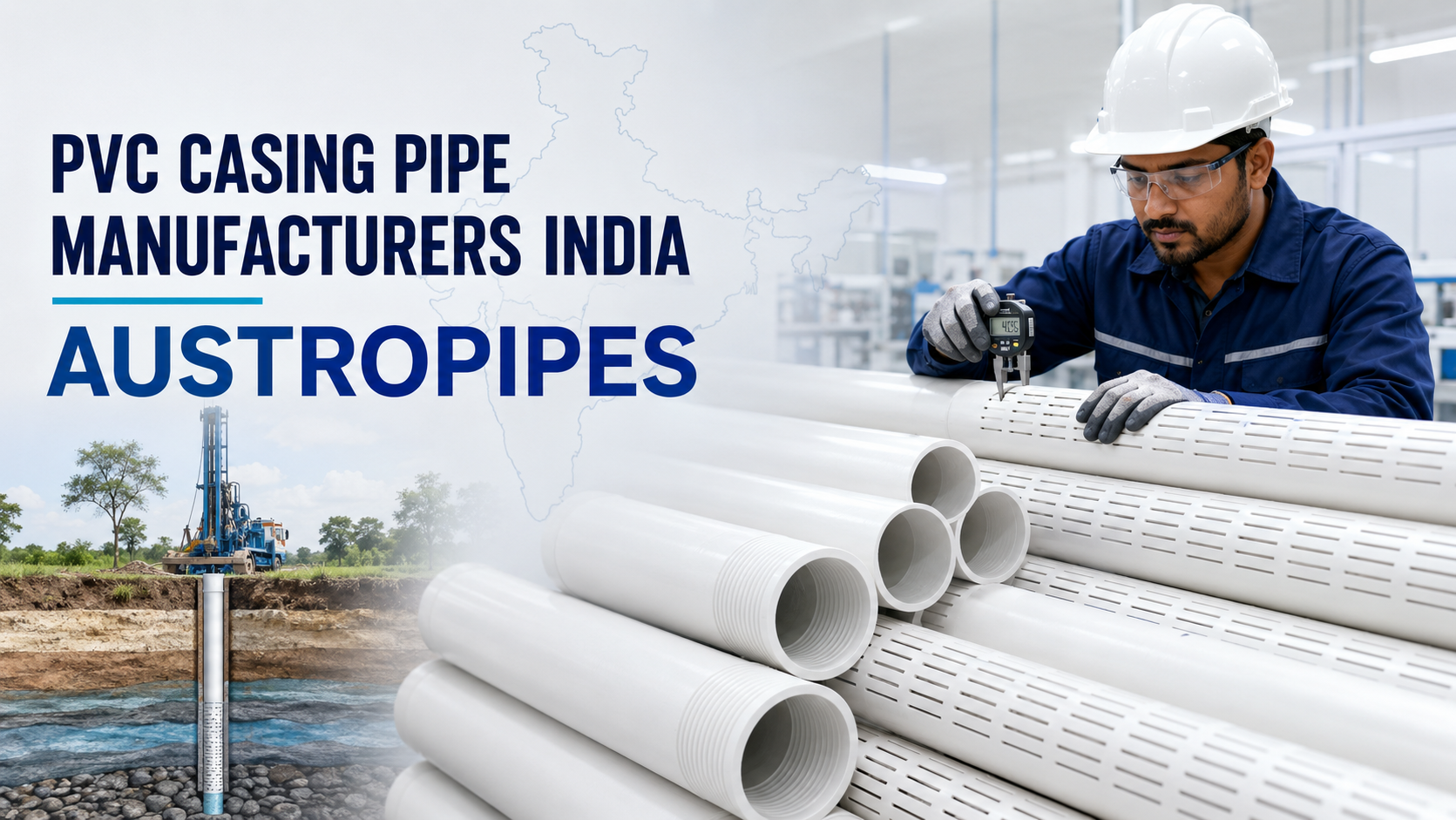
A PVC borewell casing pipe is a rigid PVC-U pipe installed in a drilled well to support the borehole and provide a controlled passage for groundwater and pumping equipment. Casing pipes generally have a solid wall, while screen pipes contain slots through which groundwater enters the well. BIS identifies casing pipes as part of the PVC-U screen and casing pipe standard for bore/tubewells.
A properly selected casing system helps:
- Stabilize the borewell wall.
- Prevent loose soil and formation material from entering the well.
- Protect the pumping system.
- Maintain a defined internal passage.
- Provide a durable connection between pipe sections.
The required pipe type and size depend on factors such as bore diameter, well depth, geological conditions, and the intended pumping arrangement.
Why Do Borewell PVC Pipes Crack or Collapse?
Borewell casing failure usually results from a combination of incorrect pipe selection, excessive external loading, poor handling, or improper installation rather than one isolated issue.
The most common causes include:
1. Choosing an unsuitable casing class
PVC-U casing pipes are available in classifications intended for different well conditions and depths. IS 12818 covers casing designations including shallow, medium, and deep-well applications.
Using a casing pipe that is not appropriate for the expected external load can increase the risk of deformation or collapse.
2. Excessive external pressure
Unlike a pressurized water-supply line, a borewell casing can experience substantial pressure from the surrounding formation. As depth and groundwater conditions change, the external loading on the pipe must be considered during design.
A pipe that looks sufficiently strong above ground may not be suitable for a particular underground installation.
3. Impact and mishandling
PVC-U has useful rigidity but can be damaged by impacts and external blows. BIS guidance specifically notes that PVC-U pipes require care during laying and can be susceptible to damage from impacts.
Dragging pipes over rough surfaces, throwing them during unloading, or forcing damaged joints together can create defects that later become failure points.
4. Poor alignment during installation
A casing string should be installed with appropriate alignment and without forcing pipe sections into an unsuitable bore. Excessive bending or misalignment can place unnecessary stress on the pipe and joints.
5. Incorrect joints or threading
The connection between casing sections is as important as the pipe itself. IS 12818 includes requirements relating to threading of casing and screen pipes, as well as sealing elements.
A poor-quality or incorrectly assembled joint can become a weak point even when the pipe body meets the required specifications.
How Do PVC Casing Pipes Prevent Borewell Failure?
The basic principle is simple: the casing must provide adequate structural support while remaining dimensionally stable under the conditions expected inside the well.
For project selection, manufacturers and engineers should evaluate:
- Borewell depth – Greater depths may impose different mechanical demands.
- Bore diameter – The casing must fit the designed bore and pumping arrangement.
- Ground conditions – Soil, rock, loose formations, and groundwater conditions affect casing requirements.
- Pipe designation and dimensions – The selected product should correspond to the applicable standard and intended application.
- Joint configuration – Connections should be compatible with the specified casing system.
- Installation procedure – Handling, lowering, alignment, and joining should follow the manufacturer’s recommendations.
BIS documentation for IS 12818 includes requirements covering dimensions, external-blow resistance, tensile strength, Vicat softening temperature, density, threading, and sealing elements. These checks illustrate why casing selection should go beyond simply measuring outside diameter and wall thickness.
What Should You Check When Choosing PVC Casing Pipe Manufacturers India?
For a borewell project, buyers should evaluate the manufacturer’s technical documentation and product compliance before placing an order.
Check the applicable Indian Standard
For PVC-U borewell screen and casing pipes, the relevant standard is IS 12818:2010. BIS lists IS 12818 among its product-specific standards for PVC-U screen and casing pipes for bore/tubewells.
Do not automatically treat the term “ISI pipe” as proof of compliance. Ask for the applicable BIS licence or certification details and verify them through official BIS resources where required.
Examine product specifications
Ask for information covering:
- Nominal diameter and dimensions.
- Casing designation or class.
- Applicable well-depth range.
- Joint and threading details.
- Material specifications.
- Relevant test and quality documentation.
This is particularly useful for procurement teams comparing rigid PVC pipe manufacturers for different applications.
Evaluate manufacturing consistency
A casing pipe needs consistent dimensions and mechanical properties along its production length. For dealers and contractors, consistency also reduces problems during joining and installation.
A manufacturer serving the borewell market should be able to explain its quality-control process rather than relying only on general claims about pipe strength.
Are PVC Casing Pipes the Same as PVC Water Supply Pipes?
No. PVC water-supply pipes and borewell casing pipes may both be made from PVC, but they serve different purposes and should not be treated as interchangeable products.
PVC-U water-supply products are covered by standards such as IS 4985:2021, while PVC-U screen and casing pipes for bore/tubewells are covered by IS 12818:2010.
This distinction matters when buyers approach PVC water pipe manufacturers for a borewell project. The correct product should be selected according to the application and applicable standard, not simply according to material or nominal diameter.
Installation Practices That Help Prevent Cracks and Collapse
Even a correctly manufactured casing pipe can fail if installation is poorly controlled.
A practical installation approach includes:
- Confirm the bore design before selecting pipe dimensions and casing class.
- Inspect every pipe for visible cracks, deep scratches, deformation, or damaged threads.
- Store pipes correctly on a reasonably flat surface and protect them from unnecessary impact.
- Keep the casing aligned during lowering rather than forcing sections into position.
- Use compatible joints and sealing components according to the pipe system.
- Avoid excessive force during assembly.
- Follow the manufacturer’s installation guidance for the specific casing product.
- Inspect the completed casing string before finalizing the borewell installation.
Contractors should also coordinate the casing selection with the borewell driller and project engineer. A pipe cannot compensate for an unsuitable bore design or careless installation.
Why Local Project Conditions Matter in Hyderabad
Borewell requirements in Hyderabad can vary from one project site to another. Geological formation, drilling depth, bore diameter, groundwater conditions, and the intended pumping system should therefore be considered before final product selection.
For builders, consultants, and contractors, the better approach is to provide the pipe manufacturer with the actual project requirements instead of asking only for the “strongest” or lowest-cost casing pipe.
This helps the supplier recommend a product based on engineering requirements rather than a generic specification.
What About Agriculture Borewell Applications?
Agricultural borewells can place different demands on casing systems because they may involve substantial depths, repeated pumping cycles, and site-specific geological conditions.
When sourcing from agriculture PVC pipe manufacturers in India, buyers should distinguish between agricultural water-distribution pipes and pipes specifically intended for borewell casing. The application, standard, dimensions, and mechanical requirements should be confirmed before procurement.
For large projects, consultants and contractors can also request product test documentation and relevant compliance information as part of technical evaluation.
How Can Dealers and Contractors Reduce Borewell Pipe Failures?
The most effective strategy is to treat pipe procurement, storage, and installation as one system.
For manufacturers: maintain dimensional and material consistency and provide clear technical documentation.
For distributors and dealers: stock clearly identified products and avoid mixing specifications that appear similar but have different applications.
For plumbers and contractors: inspect pipes before installation and follow joining and handling instructions.
For consultants and engineers: specify the applicable standard, dimensions, casing requirements, and project conditions in the technical schedule.
For builders and homeowners: select products based on technical suitability and compliance rather than price alone.
What Is the Cost of PVC Borewell Casing Pipe?
There is no single standard price because casing cost depends on diameter, designation, wall dimensions, length, quantity, location, specifications, and market conditions. Installation, transportation, drilling, joining components, and site conditions can also materially affect the total borewell cost.
Instead of comparing only the price per metre, project buyers should compare the complete compliant casing specification and the documentation supplied with it. A lower initial price may not represent lower project cost if the selected pipe is unsuitable for the application.
Why Work With a Technical PVC Manufacturer?
For a company such as Austro Pipes, the useful value of a manufacturing partner is not simply supplying lengths of pipe. The manufacturer should help customers identify the appropriate product specification, understand applicable standards, and use the pipe correctly.
Borewell projects involve multiple parties—from manufacturer and distributor to contractor, consultant, and end user. Clear technical communication between these parties can reduce avoidable errors before the pipe reaches the bore.
Conclusion
Preventing borewell cracks and collapse starts before installation. The right PVC-U casing must match the well’s depth, diameter, geological conditions, mechanical requirements, and applicable Indian Standard. Proper handling, compatible joints, careful installation, and quality documentation are equally important.
When evaluating PVC casing pipe manufacturers India, buyers should look beyond price and ask for application-specific specifications and compliance information. Austro Pipes can use these considerations as a practical framework for helping distributors, contractors, engineers, builders, and homeowners make more informed casing-pipe decisions for borewell projects in Hyderabad and other Indian markets.
Need the Right PVC Casing Pipe for Your Borewell Project?
Choosing the right casing pipe can help reduce the risk of cracking, deformation, and premature borewell failure. For product specifications, suitable casing options, bulk requirements, or project-specific guidance, Learn more about Austro Pipes and discuss your requirements with the team. Get in Touch
Call: +91 99495 04930
Email: info@austropipes.com
Frequently Asked Questions
Which Indian Standard applies to PVC borewell casing pipes?
IS 12818:2010 covers unplasticized PVC (PVC-U) screen and casing pipes for bore/tubewells. BIS documentation describes different casing and screen designations and includes requirements related to dimensions, mechanical properties, threading, and sealing components.
Why does a PVC casing pipe collapse underground?
Collapse can occur when the selected casing is unsuitable for the external loads imposed by the borewell conditions. Incorrect designation, excessive pressure, damaged pipe sections, poor installation, or unsuitable bore design can contribute to failure. Casing selection should therefore consider depth, bore diameter, formation, and applicable specifications.
Can a normal PVC water pipe be used as borewell casing?
Not automatically. Water-supply pipes and borewell casing pipes have different applications and applicable standards. A PVC pipe intended for water distribution should not be substituted for a borewell casing product without confirming that its design and specifications are suitable for the particular borewell.
What should I ask a PVC casing pipe supplier before buying?
Ask for the applicable Indian Standard, product designation, dimensions, material information, joint details, recommended application or depth range, and relevant quality or test documentation. Also provide the supplier with borewell depth, bore diameter, geological information, and project requirements so the product can be evaluated correctly.
How can contractors prevent casing pipe cracks during installation?
Inspect pipes before use, store them carefully, protect threads and ends from impact, maintain alignment during lowering, and avoid forcing or excessively bending the casing. Joints and sealing elements should be assembled according to the manufacturer’s instructions and applicable product requirements.
Is a thicker PVC casing pipe always better?
Not necessarily. Casing selection should be based on the actual mechanical and installation requirements of the borewell. Simply choosing the thickest available pipe can increase cost without addressing other design issues. The appropriate casing designation, dimensions, material properties, and installation method should be considered together.
How do I verify whether a PVC pipe manufacturer follows BIS requirements?
For products covered by a BIS standard, buyers can check the applicable standard and relevant certification/licensing information through official BIS resources. BIS publishes product manuals and maintains databases containing information related to Indian Standards and testing facilities.