How to Store and Handle PVC Pipes on Site Before Installation
PVC pipes leave the factory in good condition, but the weeks they spend on a truck, in a yard or at a project site decide how well they perform later. Most site damage is quiet: a pipe that spent a month in direct sun, lay under a stack of heavy material, or was dragged across sharp rubble can carry weaknesses that only show up after the line is closed and the walls are finished. This guide walks through simple, practical habits for storing and handling PVC pipes before installation, so the pipe you fit is as good as the pipe you bought.
Why storage and handling matter more than people think
PVC is a tough material, which is exactly why handling damage is easy to ignore. A pipe does not crack the moment it is dropped or bent. Instead, small stresses build up: a slight oval shape from a strap pulled too tight, a roughened outer surface from dragging, or a fine crack near the socket that stays invisible until the line is pressurised.
The costs of that quiet damage add up quickly. Replacing a pipe inside a finished bathroom or under a laid floor means breaking tiles, re-doing masonry and often losing days of work. Compared to that, spending a little care on storage and handling is the cheapest quality control on the whole project.
Manufacturers test pipes for strength and long-term performance under standard conditions. Those tests assume the pipe reaches the joint in the condition it left the plant. Storage and handling are the part of the journey the manufacturer cannot control, which makes them the site team’s responsibility.
Choosing the right storage spot
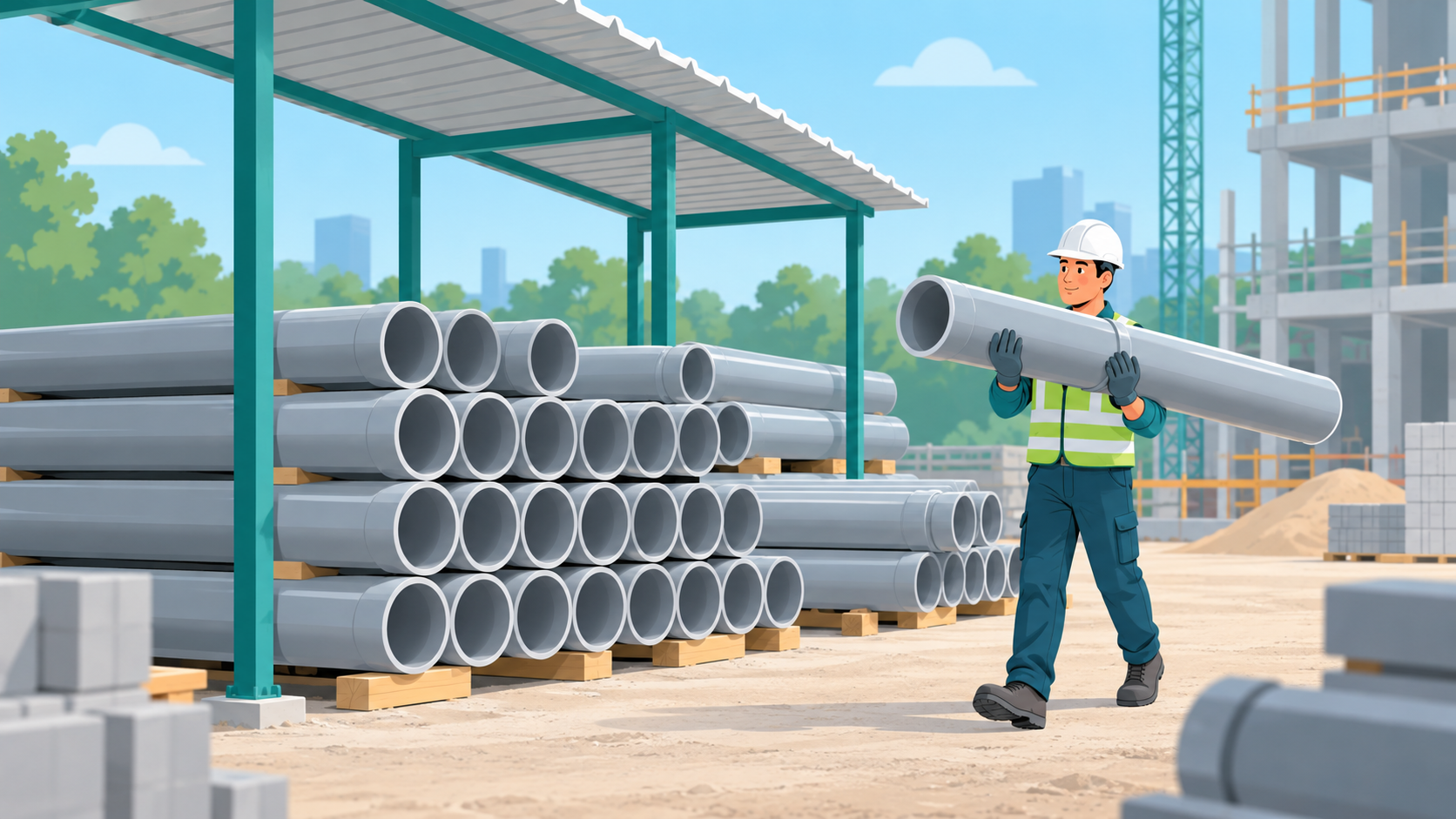
The best place to keep PVC pipes is a covered, level area away from direct sunlight and heat sources. A simple shed, a shaded corner of the site or even a tarpaulin-covered rack works well, as long as air can move around the stack.
Sunlight is the main enemy during storage. Long exposure to direct sun slowly affects the outer surface of the pipe and can make it less forgiving during cutting and jointing. If pipes must stay outdoors for a while, cover them with an opaque, breathable sheet held loosely over the stack so air can still move through. Sealed plastic covers, especially dark ones, trap heat and can make the stack warmer than open air.
Keep the storage area away from anything that runs hot: generator exhausts, welding zones, bitumen boilers and freshly poured concrete that is still curing. PVC softens with heat, and even moderate warmth over days can leave a permanent bend in pipes at the bottom of a stack.
The ground under the stack matters too. Level, dry ground keeps the load even across the bundle. A stack sitting on uneven rubble puts point pressure on a few pipes, and those pipes carry that dent for life.
Stacking pipes the right way
Stack pipes on flat, continuous supports rather than on a few bricks or blocks. Wooden battens placed across the full width of the bundle, spaced evenly, spread the load and keep the bottom layer round. If pipes are stored in their original bundles, keep the bundles intact until the pipes are needed.
Keep stacks reasonably low. A very tall stack puts real weight on the lowest layer, and pipes at the bottom can slowly flatten into an oval shape. An oval pipe is hard to joint properly, because the socket and spigot no longer meet evenly.
Store different diameters separately where possible. Nesting small pipes inside large ones saves space but makes it easy to crack a thin-wall pipe when the bundle shifts. If sizes must share a rack, keep heavier, larger pipes at the bottom and lighter ones on top.
Sockets deserve special attention. Where pipes are stacked socket-to-spigot in alternating directions, the sockets sit in the gaps and the load stays on the pipe barrels. A stack where all sockets line up on one side tends to lean, and the sockets themselves carry weight they were not shaped to carry.
Moving pipes around the site
Most handling damage happens in the last hundred metres, between the storage rack and the trench or shaft. A few habits prevent almost all of it.
Carry pipes, do not drag them. Dragging a pipe across concrete, metal edges or rubble scuffs the outer wall. On a pressure line, a deep scratch is more than cosmetic, because the scratch tip can become a starting point for a crack under load. Two people can carry long lengths comfortably, one near each end.
When loading or unloading a vehicle, lower pipes instead of dropping them. A pipe dropped on its end can split at the socket or develop a fine crack at the point of impact. The pipe may look fine and still fail later. If a pipe does take a hard knock, mark it and inspect it carefully before it goes anywhere near a joint.
Keep pipes away from sharp edges during transport. On a truck, rest pipes along the full length of the bed rather than letting them overhang. Overhanging pipes vibrate and flex on the road, and repeated flexing tires the material in the same way bending a wire back and forth tires it.
Straps and ropes should be snug, not tight. A strap pulled hard over a small diameter pipe can flatten it slightly, and that flattening is often permanent. Wide webbing straps spread the load better than thin ropes or wires.
Weather, dust and site chemicals
PVC handles rain without trouble, so a wet pipe is not a problem. What matters is what the rain leaves behind: mud and grit inside the pipe. Any dirt inside the pipe must be cleaned out before jointing, because grit trapped in a solvent joint weakens the bond. End caps or even simple plastic bags tied over the open ends keep the inside clean while pipes wait on site.
Certain chemicals common on sites do not sit well with PVC. Solvents, some adhesives, paints and fuel can soften or stain the pipe surface. Store pipes away from paint shops, fuel storage and areas where solvent-based products are used. If a pipe picks up a chemical splash, clean it and check the surface before use.
Cold weather makes PVC less flexible and more likely to crack under a sharp impact. In cold conditions, handle pipes a little more gently and let chilled pipes warm up naturally before cutting or jointing. Do not warm them over a flame or heater.
Checks before a pipe goes into the joint
A quick inspection before installation takes less than a minute per pipe and catches almost everything storage and handling can do:
Look along the pipe from one end. It should be straight, without a visible curve or flat spot. Run a hand over the surface to feel for deep scratches, cuts or rough patches. Check the socket and the spigot ends closely, because these are the parts that form the joint. Look inside the pipe for mud, stones or construction waste. Tap the pipe lightly and listen; a clear ring suggests a sound pipe, while a dull thud near a suspect mark deserves a second look.
Any pipe with a visible crack, a deep gouge or a flattened section should be set aside. Cutting out a damaged portion and using the sound length for a short run is a reasonable way to avoid waste, as long as the remaining piece passes the same inspection.
Special notes for different pipe types
Plain PVC pipes used for water supply follow all the guidance above. UPVC pipes are stiffer and slightly less forgiving of impact, so they benefit even more from careful carrying and low stacks. CPVC pipes used for hot water lines should never be stored near heat, because their material is chosen for hot service inside a wall, not for weeks of baking in the sun before installation.
Drainage products such as UPVC SWR pipes often come with rubber rings fitted in the sockets. Keep those rings clean and in place, because a twisted or dirty ring is a common cause of slow leaks in drainage lines. Electrical conduit pipes are lighter and thinner walled than plumbing pipes, so they dent more easily and should never carry the weight of heavier bundles.
Building the habit into the site routine
Storage and handling rules only work when they are part of the daily routine rather than a one-time instruction. A few practical steps help. Give one person clear responsibility for the pipe yard, so damage has an owner. Unload deliveries against a simple checklist: count bundles, look for transit damage, and note anything suspect before signing for the material. Keep the oldest stock at the front so pipes are used in the order they arrived. And brief every new helper on the two rules that prevent the most damage: do not drag, and do not drop.
Site teams that follow these habits rarely meet a surprise failure after commissioning. The pipe that goes into the joint in factory condition behaves the way the manufacturer intended, and the line stays out of sight and out of mind for years.
A word on quality at the source
Good handling protects a good pipe, but it cannot improve a poor one, so sourcing matters as much as storage. Austro Plastic Industries LLP, an ISO 9001:2015 certified company, has manufactured PVC piping products in Hyderabad since 2016, with in-house quality testing for its range. Starting with pipes made to recognised standards and then protecting them on site gives a project the best chance of a trouble-free service life. To plan your requirement, you can request a quote with your sizes and quantities.
Receiving a delivery: the first ten minutes
Damage prevention starts when the truck arrives, not when the pipes reach the rack. Before unloading, look over the load as it sits on the vehicle. Pipes sticking out beyond the bed, bundles that have shifted, or straps cutting into the top layer are signs the journey was rough, and those bundles deserve a closer look as they come off.
Unload bundle by bundle where possible instead of tipping the load off the side. Count the bundles and lengths against the delivery note while everything is still in front of you. If a bundle arrives torn or pipes show visible cracks, note it on the delivery copy and inform the supplier the same day, with photographs if possible. Most suppliers resolve transit damage smoothly when it is reported immediately; it becomes a difficult conversation a week later when the pipes are already mixed into site stock.
Keep the delivery paperwork. Batch details on the invoice help if a question about a specific lot comes up later, and they make it easier to match pipes to the manufacturer’s test certificates when a project requires them.
Long-term storage on slow projects
Some projects buy material early and install over several months. Long storage needs a little extra planning beyond the basics. Re-check covered stacks every few weeks: tarpaulins tear, weights shift and rainwater pools where it should not. Rotate stock so older pipes are used first, especially if part of the material sits closer to sunlight than the rest. Keep a simple register of what arrived and when, so no bundle spends a season forgotten at the back of the yard.
If pipes have been stored for a long time, give them the full pre-joint inspection even if they were perfect on arrival. Rubber rings in socketed pipes should be checked for flat spots or stiffness after months in storage, and replaced if they no longer sit evenly in the groove.
Common mistakes that keep repeating on sites
The same handful of mistakes causes most pre-installation damage. Storing pipes upright leaning against a wall lets them bow under their own weight; always lay them horizontally on supports. Using pipe stacks as a work platform or as a base for other materials crushes the bottom layer slowly. Leaving the open ends uncovered near plastering or cutting work fills the bore with dust that later enters joints. Throwing fittings loose into a toolbox chips their edges; keep fittings in their boxes until use. And dragging the last few pipes across the floor because the rack is nearly empty is how many good stacks end with one bad length.
None of these habits survive a quick walk-through with the site supervisor, which is why a weekly two-minute look at the pipe yard pays for itself many times over.
Handling fittings, valves and small parts
Pipes get most of the attention, but fittings fail quietly too. Elbows, tees, couplers and valves are usually packed in boxes or bags, and they should stay that way until the day they are installed. Loose fittings rolling around a toolbox collect scratches on their sockets, and a scratched socket never seals as well as a clean one. Store fittings off the ground, away from sunlight for the same reasons as pipes, and keep rubber rings, gaskets and solvent cement tins in a cool, dry box. Solvent cement has a usable life; a tin that has sat open in the heat thickens and stops bonding properly, so close tins tightly after every use and replace any cement that has gone stringy or lumpy.
A simple storage routine any site can follow
Putting all of this together, a workable routine looks like this. On delivery day, inspect, count and note damage before signing. Move bundles to a shaded, level rack the same day rather than leaving them on the truck bed or the roadside. Keep ends covered and fittings boxed. Use the oldest stock first, brief new hands on the carry-not-drag rule, and give every pipe a ten-second inspection before it is cut or jointed. Sites that follow this routine turn storage from a quiet source of failures into a non-event, which is exactly what it should be.
Key takeaways
Store PVC pipes covered, shaded and on level supports, away from sunlight and heat. Keep stacks low, sockets protected and sizes separated. Carry rather than drag, lower rather than drop, and strap snug rather than tight. Keep pipe ends covered against dirt, keep chemicals away, and inspect every pipe before jointing. These habits take minutes and save the most expensive kind of repair: the one hidden inside finished work. Treat the pipe yard with the same care as the joint itself, and the material will repay it in service.