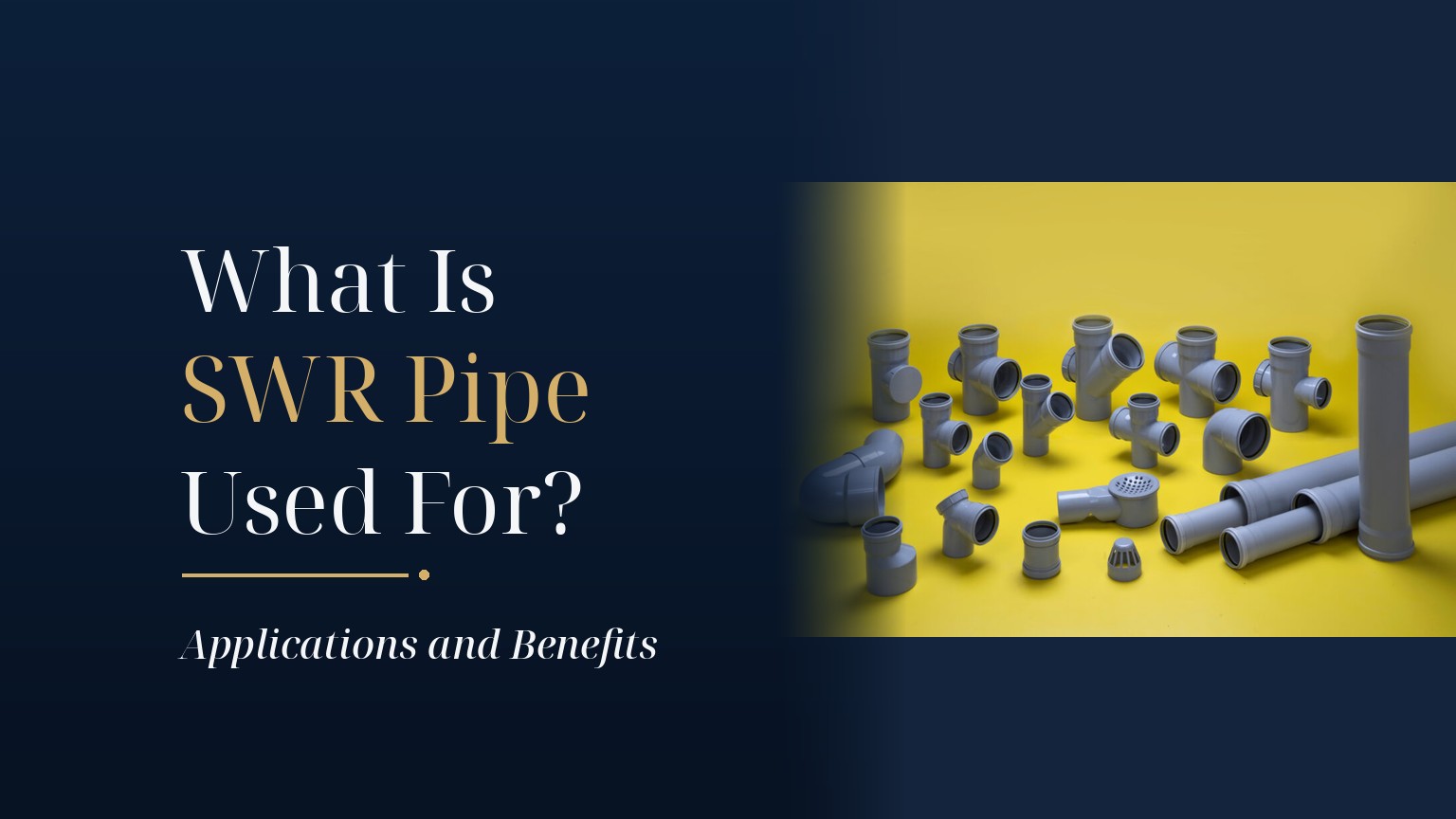
Choosing the right drainage pipe is less about a generic “plastic versus metal” debate and more about matching each line to its job. Soil, waste, rainwater and ventilation systems carry different loads and face different code requirements, while exposed installations add UV, noise and expansion concerns.
This guide explains what is SWR pipe used for, how IS 13592 Type A and Type B differ, where SWR works best, and how to specify, install and buy it. It also explains where UPVC underground drainage and DWC systems are stronger alternatives.
SWR Type A vs Type B: Applications, Standards and Rainwater Systems
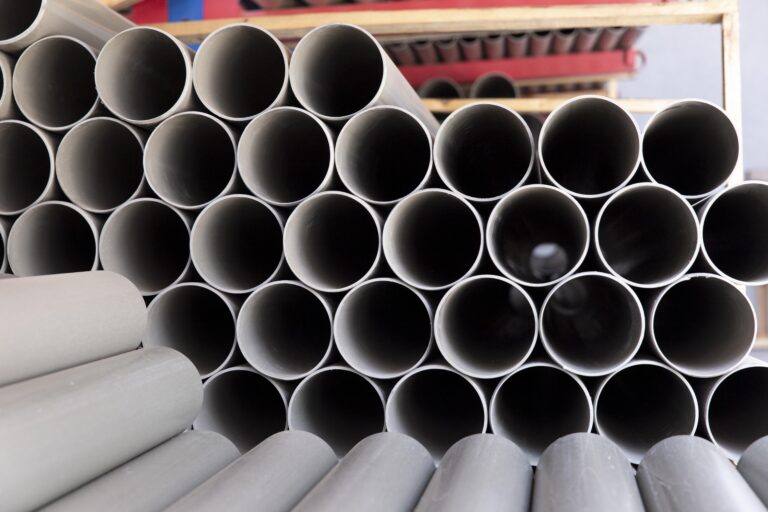
IS 13592 draws a useful line between two applications. Type A covers ventilation pipework, rainwater systems and rainwater harvesting. Type B covers soil and waste discharge systems. The distinction is not a change of resin or colour: both are dark-grey PVC-U products whose resin and dimensions are set by the standard. The scope spans DN 40 to 315 mm for indoor and outdoor building drainage. At DN 110 mm, the cited standard gives a wall range of about 2.2–2.7 mm for Type A and 3.2–3.8 mm for Type B, reflecting the different structural demands. The standard also includes a sunlight-exposure test (Clause 8.5) for products intended for outdoor use. These figures come from BIS IS 13592 , so they should be checked against the current standard and the manufacturer’s certified dimensions before ordering.
That classification changes the specification. A Type A stack or rainwater line must not be substituted with a Type B pipe merely because both are labelled SWR; using Type B for a vent or rain line may add cost without improving the installation. In a multistorey building, a soil stack carries waste into a branch or main, while a separate vent stack extends through the roof to admit air and relieve pressure. Rainwater lines receive roof runoff through hoppers, outlets and downpipes, then convey it to an approved discharge or harvesting system. Kitchen waste needs a local grease trap or interceptor before joining the main. The specification should state branch test methods, permitted fittings and stack support, plus inspection access, cleaning points and acoustic requirements. Type A and Type B are not interchangeable even when diameters match.
Installation Guide: Solvent Cement Joining, Curing and Common Mistakes
Correct installation matters as much as the material. First, confirm that the pipe and fittings belong to one compatible drainage system; dry-fit every run before solvent cement is applied. Mark insertion depth using the fitting manufacturer’s template, cut square with a fine-toothed saw, deburr the edge, and clean both pipe and socket with the specified cleaner. Apply the approved solvent cement evenly to the socket and pipe, insert the pipe fully to the mark, hold it in position, and allow the joint to cure undisturbed. Cure time depends on pipe diameter, cement type and ambient temperature, so use the product-specific instruction rather than a generic internet timer; a warm, dry room and a cold, humid room do not cure alike.
Common failures start before the joint is made: cutting without a square, forcing a misaligned run, reusing contaminated brushes, applying excess cement or joining dry components. After curing, check alignment and support the run with brackets that carry the weight without stressing sockets. Maintain the design gradient, avoid unsupported spans, and use swept branches or approved fittings instead of improvised bends. Never heat the pipe to reshape or cure it. Before concealment, inspect sockets and conduct the air or water test specified in project documents, recording pressure, duration and result. Vents must remain unobstructed and meet the required termination height. Keep roof outlets, terrace and floor traps, cleanouts and vent terminals accessible for inspection; these are service points, not optional details. A photographed, tested installation is easier to diagnose than a buried network opened after a leak.
SWR vs Other Drainage Pipe Systems
SWR, UPVC Underground Drainage Pipes and DWC Pipe can all serve non-pressure drainage, but they are not interchangeable labels. SWR is a broad building-drainage solution covering soil, waste, rainwater, vent and harvesting duties under IS 13592. Austro’s underground drainage pipes are intended for below-ground drainage, while DWC uses a double-wall corrugated construction commonly considered where greater ring stiffness or improved load distribution is important. Exact suitability depends on the standard, diameter, wall class, bedding and design load; neither “DWC” nor “red pipe” by itself proves capacity. For buried lines, the designer must also check cover, soil conditions, groundwater, traffic loading and jointing method.
The practical comparison is straightforward. Use SWR where a compliant Type A or Type B system is required for building stacks, branches, vents and rainwater. Use solid-wall underground drainage where its approved specification covers the buried application. Consider DWC when project design calls for a double-wall profile, higher stiffness or a particular installation benefit; the additional material and fittings must be justified by the structural and lifecycle design, not by appearance. Soil, waste and stormwater networks should remain logically separated until the point allowed by local rules, with rainwater kept out of the sewer line wherever policy requires it. For a building project, compare complete systems rather than unit prices: pipe and bends, branches and sockets, traps, brackets, couplers, inspection access, testing and labour all affect the installed result. A cheaper pipe that lacks compatible fittings or documentation can become the costlier option.
Benefits, Limitations, Maintenance and Service Life
The strongest reasons to choose correctly specified SWR are practical. uPVC is lightweight compared with cast iron, so handling and installation are easier, and it does not rust in damp soil or concealed conditions. A smooth internal surface supports efficient flow, while properly made solvent-cement joints create a continuous, leak-resistant network. The material suits both indoor stacks and approved outdoor drainage routes, and its light weight can reduce handling effort on terraces and multi-storey sites. For developers, a standardised PVC-U system also simplifies coordination between waste and rainwater packages: one pipe family can cover multiple branches, provided the Type A or Type B classification is correct. For distributors, availability of compatible elbows, tees, sockets, bends and traps matters as much as stock depth.
SWR also has boundaries. It is a gravity and ventilation system, not a pressure-rated potable-water main, and should not be assumed suitable for gas, compressed air or hot water. Exposure, loading, temperature and chemical discharge can change design requirements; check the applicable standard and local code rather than relying on a generic warranty. Expansion joints, adequate brackets and correctly sized offsets should be detailed where movement is expected. Maintenance is simpler than metal systems because there is no internal rust correction, but “maintenance-free” is not a substitute for inspection. Keep roof and terrace traps accessible, clean them periodically, check jointing workmanship at commissioning, and record the as-built route. Service life is not universal: it depends on material grade, installation, exposure, loading and maintenance, and should not be represented by an unsupported fixed-year claim. Owners and facility teams should keep a planned preventive schedule.
Recent policy and research sharpen the role of SWR in resilient drainage. Rajasthan’s Sewerage Policy requires storm-water drainage to be developed separately from sewerage, with no short-circuiting or connectivity, because runoff can carry impurities and overload a sewage system. It also calls for separate house outlets for kitchen, bathroom and toilet waste and for rooftop or open-area runoff, with suitable local rainwater harvesting. That principle translates into two SWR design strategies: Type A for rainwater and vent duties, and Type B for soil and waste duties, kept hydraulically distinct. The scale is significant in Indian cities. A Hyderabad geospatial study estimated 141.21 billion litres of annual rooftop harvesting potential—enough to meet up to 32.75% of basic domestic demand and 29.47% of standard urban demand in its modelled scenarios. Such systems still need correct sizing, first-flush management where specified, filtration and safe storage.
A second issue is acoustic performance. In a documented Korean apartment retrofit study , replacing conventional PVC drainage with low-noise PVC, an absorbing ceiling and soundproof doors reduced toilet-drainage noise from 59.8 dB(A) to 36.9 dB(A), a 22.9 dB(A) improvement. Sink noise fell by 16.6 dB(A), and every measured post-retrofit condition was below 40 dB. A companion 2026 study examined conventional pipe, low-noise pipe, damping sheet and composite wraps, showing that airborne and structure-borne sound need different controls. Pipe selection therefore matters, but brackets, isolation and the surrounding structure matter too. The new BS EN 1329-1:2026 also reflects continuing development in PVC-U soil-and-waste systems. In 2026, the best SWR specification is not merely “PVC”: it defines class, acoustic duty, joints, supports, testing and separation.
Buying Guide: IS 13592, Sizing and Supplier Questions
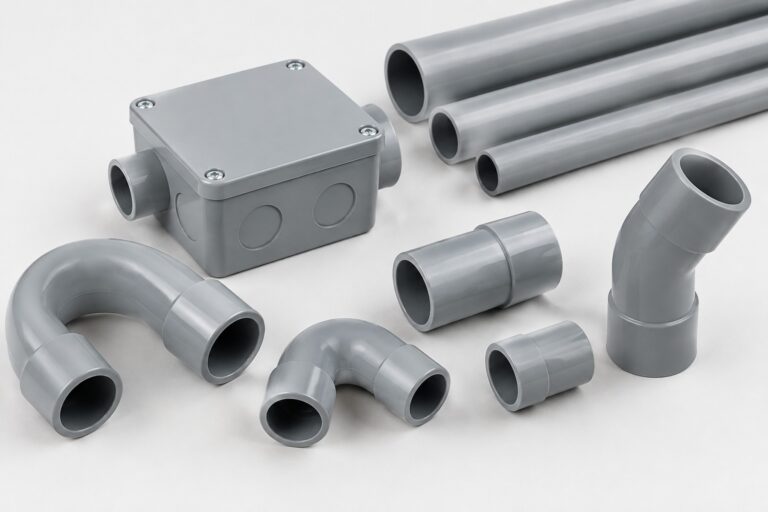
A disciplined buying guide prevents most substitution errors. Start with the complete design requirement: application, nominal size, standard, class, joint, colour, installation method and test method. For Indian soil, waste, rainwater and vent work, request evidence of compliance with IS 13592 and check that the supplier’s dimensions and markings match the certificate or technical documentation. Confirm that pipes and fittings come from a compatible system, especially sockets, bends and branches. Sample the batch for consistent wall thickness, socket fit and legibility, and verify how the product is protected from sunlight during storage. For a multi-system project, compare the availability of Type A and Type B components, roof and terrace accessories, and compatible underground drainage. Do not accept a substituted “equal” pipe without written confirmation that its application, dimensions and standard match the design.
Supplier capability is part of the specification. Austro Plastic Industries LLP, established in 2016 and headquartered in Hyderabad, is a B2B wholesale manufacturer and dealer distributor with more than 3,000 dealers across Andhra Pradesh and Telangana. The company is ISO 9001:2015 certified, applies ISI-standard testing in its company laboratories and maintains stringent in-house quality checks. Buyers can review About Austro Plastic Industries LLP for company details, then use Contact Austro Pipes for dealer, bulk or project enquiries. Austro does not publish fixed prices; quotations vary with product, size, quantity and commercial terms, so request a current quote rather than relying on an obsolete per-metre figure. This keeps the decision based on verified fit, quality and supply support rather than unsupported product claims. It also avoids comparing different specification classes as equivalent products.
Conclusion
SWR pipe is used for building soil, waste, rainwater, vent and harvesting systems. Its performance depends on choosing the correct Type A or Type B class, designing gravity flow properly, separating stormwater from sewerage and installing compatible joints, supports and access points under the manufacturer’s instructions.
For developers, contractors and distributors, the best outcome comes from matching the complete drainage design rather than choosing a pipe in isolation. Ready to specify the next project? SWR Pipes and Fittings from Austro Pipes provide a practical starting point for a compatible, professionally specified drainage system.
FAQs
What is SWR pipe used for?
SWR pipe is used for gravity-fed soil, waste, rainwater and ventilation networks, including toilet stacks, waste branches, downpipes, roof outlets and harvesting lines. The IS 13592 Type A or Type B class must match the line’s duty.
Is SWR Type A the same as Type B?
No. Type A serves ventilation, rainwater and harvesting lines, while Type B serves soil and waste discharge. Their wall requirements differ, so confirm the intended duty before ordering.
Can SWR pipe carry drinking water?
No. SWR is designed for gravity drainage and ventilation, not pressure-rated potable-water supply. Use an approved drinking-water pipe and fitting system for supply lines.
How are SWR pipes joined?
Usually with compatible solvent cement. Cut square, clean and mark the socket, apply the specified cement, insert to the required depth, hold and cure exactly as the manufacturer directs. Never heat the pipe to accelerate curing.
Which SWR system suits a high-rise apartment?
Choose the correct Type B soil stack and Type A vent or rainwater design, then verify acoustic requirements, brackets, fire stopping and test procedures. Pipe mass alone does not guarantee quiet performance.
Does Austro Pipes publish fixed prices?
No. Prices vary by product, size, quantity and commercial terms. Request a current dealer, bulk or project quotation from the sales team.
Does Austro Pipes offer warranties or guarantees?
No specific published warranty terms are confirmed. Austro maintains stringent in-house quality checks; buyers should request the current written terms for the product and order.
What are typical bulk order lead times?
Dispatch may be direct or through the dealer network, depending on location, product availability and quantity. Delivery timelines are confirmed during quotation or order processing.