Why FRLS Conduit Pipe Manufacturers Matter in Fire-Sensitive Buildings
Electrical wiring is hidden behind walls, ceilings, floors, and service shafts, but the conduit protecting that wiring plays an important role in overall building safety. In buildings where evacuation, smoke visibility, and protection of electrical systems are critical, selecting the right conduit material deserves more attention than simply comparing prices.
FRLS conduit pipe manufacturers focus on conduit solutions designed around fire-retardant and low-smoke characteristics. FRLS generally refers to Fire Retardant Low Smoke, meaning the material is intended to resist flame propagation and produce less smoke under fire conditions than a conventional material designed without those characteristics.
For hospitals, schools, commercial complexes, offices, hotels, industrial facilities, data centres, and other high-occupancy buildings, conduit selection should be considered alongside cable specifications, installation practices, fire-stopping, and the applicable electrical and building-safety requirements.
What Is an FRLS Conduit Pipe?
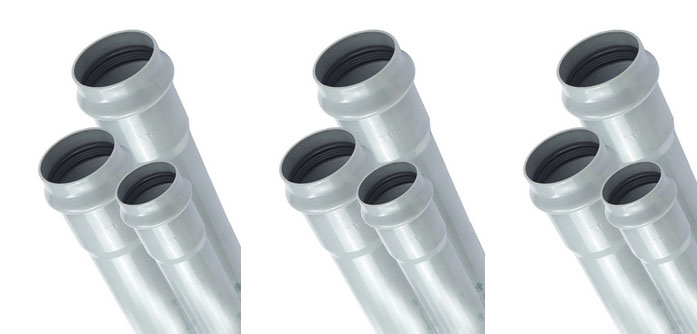
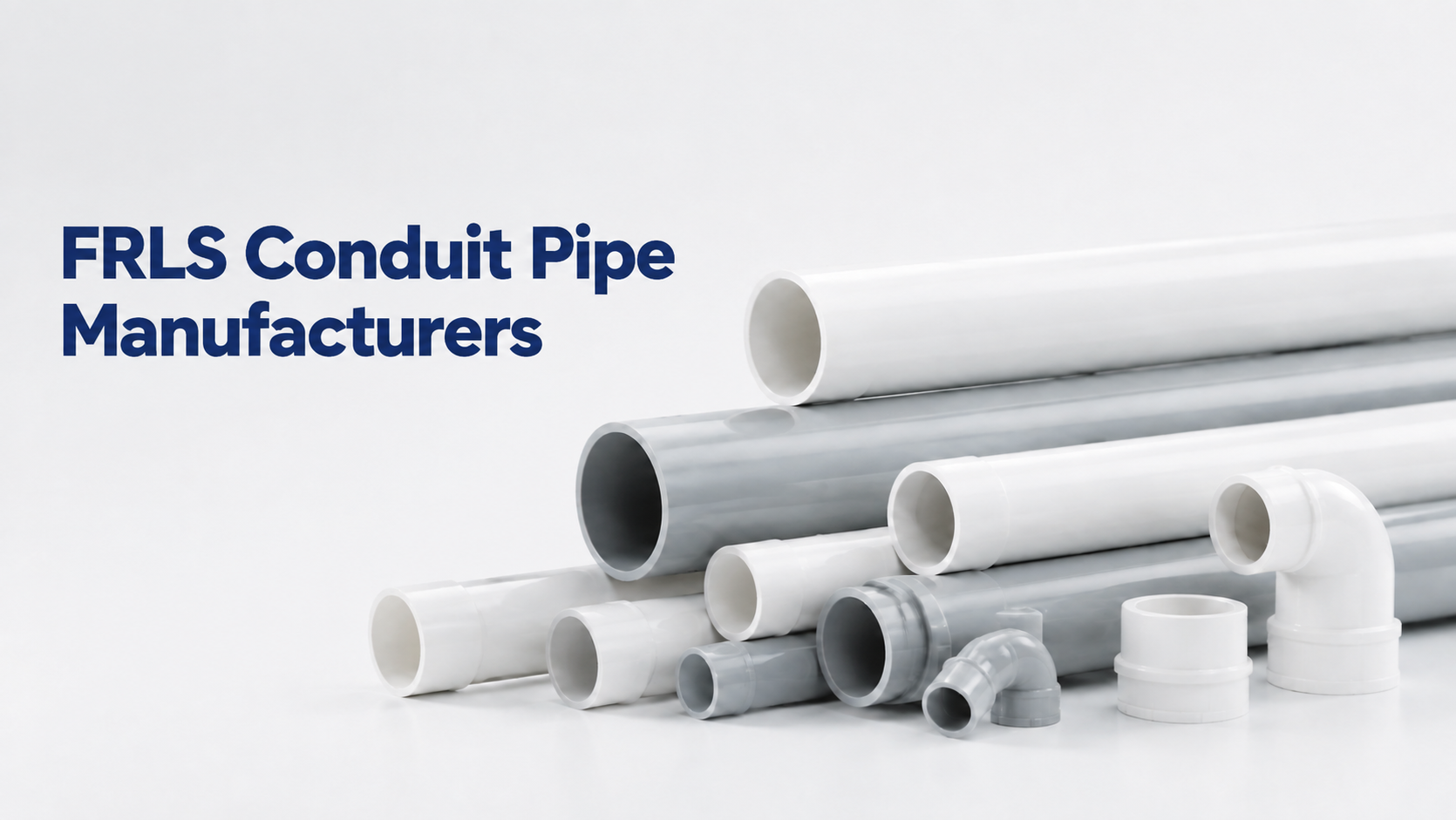
An FRLS conduit is an electrical conduit designed with material characteristics intended to reduce flame propagation and smoke generation during a fire. Its primary job remains the same as any electrical conduit: to provide a protected route for wires and cables while helping shield them from physical and environmental damage. Manufacturers such as AustroPipes, known for manufacturing PVC piping solutions, also operate in a broader industry that includes pvc water pipe manufacturers and electrical conduit products for different applications.
The low-smoke characteristic is particularly relevant in enclosed or occupied buildings because excessive smoke can reduce visibility and make evacuation more difficult. However, FRLS should not be interpreted as meaning that a conduit is completely non-combustible or incapable of being damaged by fire.
The exact performance of a product depends on its formulation, construction, testing, and applicable standard or specification. Buyers should therefore verify the manufacturer’s technical documentation rather than relying only on the FRLS label.
Why Do Fire-Sensitive Buildings Need FRLS Conduits?
The main reason is that fire safety involves more than stopping flames. Smoke, heat, damaged wiring, and loss of electrical functionality can all affect the safety of occupants and emergency response.
In a fire-sensitive building, an appropriately specified conduit can contribute to a safer electrical installation by providing:
- Protection for electrical cables against physical damage
- Controlled fire-related material performance
- Reduced smoke generation where the product is specifically designed and tested for it
- Electrical insulation when using suitable non-metallic conduit systems
- Better organization and routing of cables
- Long-term protection against moisture, dust, and environmental exposure
The conduit is only one component of the overall fire-safety system. Correct cable selection, circuit protection, installation quality, compartmentation, emergency systems, and compliance with applicable codes remain equally important.
How Does an FRLS Conduit Help During a Fire?
FRLS conduit performance is primarily related to how the conduit material behaves when exposed to heat or flame. A suitable formulation can help limit flame propagation and reduce the amount of smoke generated compared with materials that do not have equivalent fire-performance characteristics. This is one reason why buyers often evaluate PVC conduit pipe manufacturers in India based on product specifications, material quality, and documented fire-performance characteristics.
This matters because smoke can become a serious hazard before structural fire damage becomes the primary concern.
For example, consider an office building with electrical wiring routed through multiple floors. If a fire occurs near a service shaft, the performance of the conduit material can influence how the material reacts to heat and flame. However, the final outcome also depends on cable insulation, joints, penetrations, installation methods, and the building’s fire-compartmentation strategy.
BIS documentation for the IS 9537 series identifies conduits as components used to protect conductors or cables in electrical installations. The relevant testing framework includes characteristics such as dimensions, mechanical properties, resistance to heat, resistance to burning, electrical strength, and insulation resistance.
Key Benefits of FRLS Conduits in High-Risk Buildings
1. Better Fire-Performance Consideration
Fire-sensitive projects need materials selected with their behaviour under heat and fire in mind. FRLS products can be considered where fire-retardant and low-smoke characteristics are part of the project’s specification.
2. Reduced Smoke Concerns
Low-smoke characteristics can be valuable in occupied buildings because dense smoke can obstruct visibility and complicate evacuation.
3. Protection of Electrical Wiring
Conduits create a physical pathway around cables, protecting them from impact, dust, moisture, and other external conditions. AustroPipes also describes its electrical conduit products as solutions for protecting and organizing wiring in residential, commercial, and industrial applications.
4. Improved Wiring Organization
A properly designed conduit system keeps electrical cables routed in an organized manner. This makes installation, inspection, modification, and maintenance more manageable.
5. Long-Term Installation Value
The right conduit can provide durable protection for wiring throughout the service life of an installation. Choosing based only on the initial purchase price can overlook installation quality, mechanical performance, and the consequences of premature failure.
What Should You Check When Comparing FRLS Conduit Pipe Manufacturers?
Not every conduit should be evaluated solely by appearance or the words printed on its packaging. When comparing FRLS conduit pipe manufacturers, project owners, contractors, electrical consultants, and procurement teams should review the following factors:
Applicable Standards and Testing
Check which Indian Standard or project specification applies to the particular conduit. BIS lists IS 9537: Part 3 for rigid plain conduits of insulating materials, within the IS 9537 series for electrical installation conduits. BIS laboratory records also show testing against properties including resistance to burning, heat resistance, impact, compression, bending, electrical strength, and insulation resistance.
Do not assume that every product described as FRLS automatically meets every project requirement. Ask for relevant technical documentation and test evidence.
Material Quality
The raw material formulation directly influences the physical and fire-related characteristics of a conduit. Consistency between production batches is also important for large construction projects.
Mechanical Strength
A conduit should be capable of handling the conditions expected during transportation, installation, and service. Review properties such as bending, compression, impact resistance, and dimensional consistency where relevant to the specified product.
Internal Surface
A smooth internal surface can make cable pulling easier and reduce unnecessary friction during installation. AustroPipes highlights a smooth inner surface as a feature of its electrical conduit solutions.
Product Sizes and Fittings
The conduit diameter should match the number, type, and arrangement of cables being installed. Compatible bends, junction boxes, connectors, and other fittings can also simplify installation and improve system consistency.
Manufacturer Documentation
A reliable supplier should be able to provide product specifications, applicable standards, test information, installation guidance, and identification details. This is more useful than selecting a product simply because it looks similar to another conduit.
FRLS Conduit vs Standard PVC Conduit: What Is the Difference?
The key difference is the material performance expected from the product.
| Factor | FRLS Conduit | Standard PVC Conduit |
| Primary purpose | Cable protection with specified fire-related characteristics | Cable protection |
| Fire-related focus | Fire-retardant and low-smoke characteristics where specified | Depends on product formulation and specification |
| Smoke consideration | Specifically considered in FRLS formulations | Not necessarily a defining characteristic |
| Typical consideration | High-occupancy or fire-sensitive applications | General electrical installations where suitable |
| Selection approach | Verify fire-performance documentation | Verify applicable standard and product specification |
This does not mean that standard PVC conduit is automatically unsuitable or unsafe. The correct choice depends on the building, electrical design, applicable codes, environmental conditions, and project specifications.
Where Are FRLS Conduits Particularly Useful?
FRLS conduit systems can be considered for applications where occupant safety and fire performance receive greater attention, such as:
- Hospitals and healthcare facilities
- Schools, colleges, and educational institutions
- Shopping malls and commercial complexes
- Hotels and hospitality buildings
- High-rise residential buildings
- Offices and business parks
- Industrial facilities
- Data centres and technology facilities
- Transportation and infrastructure projects
The final specification should always be determined by the project’s electrical consultant, applicable standards, and fire-safety requirements.
How to Choose the Right Conduit for a Fire-Sensitive Building
A practical selection process can reduce the risk of choosing a product based only on price.
Step 1: Understand the Installation Environment
Determine whether the conduit will be concealed, surface-mounted, exposed to moisture, installed outdoors, or routed through areas with increased mechanical risk.
Step 2: Identify Fire-Safety Requirements
Check the project’s fire-safety specifications and determine whether FRLS or another specific fire-performance classification is required.
Step 3: Verify Applicable Standards
Confirm the relevant Indian Standard, project specification, testing requirements, and certification or marking requirements. BIS’s IS 9537 information provides a useful starting point for understanding conduit testing and specifications.
Step 4: Select the Correct Size
Calculate the cable arrangement and select a suitable conduit diameter. Avoid overcrowding the conduit because cable installation and future maintenance can become difficult.
Step 5: Check Fittings and Accessories
A high-quality conduit is only part of the system. Bends, junction boxes, connectors, couplers, clips, and other accessories should be compatible with the installation.
Step 6: Review Manufacturer Documentation
Compare technical specifications, test reports, quality-control information, markings, and installation recommendations before placing a bulk order.
What Are Common Mistakes to Avoid?
Even a good conduit can perform poorly if the installation is badly designed or executed. Common mistakes include:
- Selecting a conduit solely because it is inexpensive
- Treating the FRLS label as a substitute for technical verification
- Using incorrect conduit sizes
- Overfilling conduits with cables
- Using incompatible fittings
- Excessively bending or damaging the conduit during installation
- Ignoring environmental conditions
- Failing to maintain proper separation and routing
- Not checking product markings and documentation
- Assuming conduit alone provides complete fire protection
For projects comparing ISI PVC pipe brands India, the same principle applies: verify the actual product specification and applicable certification rather than choosing a brand based only on marketing language.
Why Manufacturer Selection Matters
The manufacturing process affects consistency, dimensions, mechanical performance, material characteristics, and product reliability. This is why selecting among FRLS conduit pipe manufacturers should involve more than comparing quotations.
A manufacturer should be assessed on:
- Applicable product standards
- Manufacturing controls
- Quality-testing procedures
- Product consistency
- Technical documentation
- Available sizes and accessories
- Supply capability
- Technical support
- Traceability and product identification
AustroPipes manufactures electrical conduit products for residential, commercial, and industrial applications and states that its manufacturing and quality processes include testing of conduit products.
How Much Do FRLS Conduits Cost?
There is no single price for an FRLS conduit because cost varies according to material formulation, diameter, wall construction, product classification, fittings, order quantity, transportation, and supplier.
For a project quotation, compare products on a like-for-like technical basis. A lower price is not necessarily a lower total cost if the product requires more difficult installation, has limited accessory compatibility, or does not satisfy the project’s required specification.
When evaluating the best electrical conduit pipe in India, therefore, consider compliance, fire performance, mechanical properties, installation requirements, availability, and long-term reliability alongside price.
Practical Tips for Contractors and Project Buyers
Before finalizing a conduit purchase, keep this checklist in mind:
- Confirm the required conduit type and application.
- Verify the applicable Indian Standard or project specification.
- Ask for relevant test documentation.
- Check dimensions and wall consistency.
- Confirm suitable cable capacity.
- Select compatible fittings.
- Inspect product markings and packaging.
- Purchase from an established manufacturer or authorized supplier.
- Follow the manufacturer’s installation instructions.
- Coordinate conduit selection with the electrical and fire-safety design.
A product described as a Top electrical conduit pipe brand in India should still be evaluated against the actual requirements of the project. Brand recognition can help shortlist suppliers, but technical suitability should drive the final decision.
Conclusion
Fire safety in a building depends on a complete system rather than one product, but electrical conduit selection remains an important part of responsible design. FRLS conduits can provide fire-retardant and low-smoke characteristics where those properties are required, while also protecting and organizing electrical wiring.
When comparing FRLS conduit pipe manufacturers, buyers should look beyond price and branding. Applicable standards, testing, material quality, mechanical performance, correct sizing, compatible fittings, and reliable documentation should guide the decision. For projects in India, a technically suitable conduit from a manufacturer such as AustroPipes can be evaluated against the project’s specific electrical and fire-safety requirements before procurement. Learn more about AustroPipes‘ electrical conduit pipe solutions and product specifications.
For electrical conduit requirements, contact AustroPipes to discuss the appropriate conduit solution for your project.
Get in Touch for Quality FRLS Conduit Solutions
Looking for reliable FRLS conduit pipe manufacturers for your electrical project? AustroPipes can help you explore suitable conduit options based on your application, specifications, and project requirements. Contact the team for product details, technical assistance, or bulk requirements.
Call: +91 99495 04930
Email: info@austropipes.com
Frequently Asked Questions
Is FRLS conduit completely fireproof?
No. FRLS means Fire Retardant Low Smoke and describes specific fire-related characteristics of the material. It should not be interpreted as completely fireproof or capable of maintaining electrical circuits indefinitely during a fire. Product performance should be verified through the manufacturer’s technical documentation and applicable testing requirements.
Why is low smoke important in buildings?
Low-smoke characteristics can help reduce the amount of smoke generated by a material when exposed to fire. This can be particularly valuable in occupied buildings because heavy smoke can reduce visibility and make evacuation more difficult. However, overall smoke exposure depends on all materials involved in the fire, not just the conduit.
Are FRLS conduits suitable for residential buildings?
They can be considered for residential projects when the design, specifications, and fire-safety requirements call for them. They may be particularly relevant in high-rise or high-occupancy buildings, but the appropriate conduit should always be selected according to the project’s electrical design and applicable requirements.
How do I verify the quality of an FRLS conduit?
Check the manufacturer’s technical specification, applicable standards, product markings, test reports, dimensions, mechanical properties, and relevant fire-performance information. Do not rely solely on the term FRLS printed on packaging. For larger projects, technical documentation should be reviewed before procurement.
What is IS 9537 used for?
The IS 9537 series covers specifications for conduits used in electrical installations. BIS records identify IS 9537: Part 3 for rigid plain conduits of insulating materials and show testing that covers properties such as dimensions, mechanical performance, heat, burning, electrical strength, and insulation resistance.
Can FRLS conduit be used for industrial applications?
Yes, FRLS conduit systems can be considered for industrial electrical installations when their technical characteristics match the project’s requirements. Industrial environments may also require consideration of impact, temperature, chemicals, moisture, installation exposure, and other external influences.
What should I compare between conduit manufacturers?
Compare applicable standards, testing documentation, material quality, mechanical properties, dimensional consistency, available sizes, fittings, manufacturing controls, supply capability, technical support, and total project cost. The most suitable FRLS conduit pipe manufacturers are those whose products can be technically verified against the requirements of your specific installation.