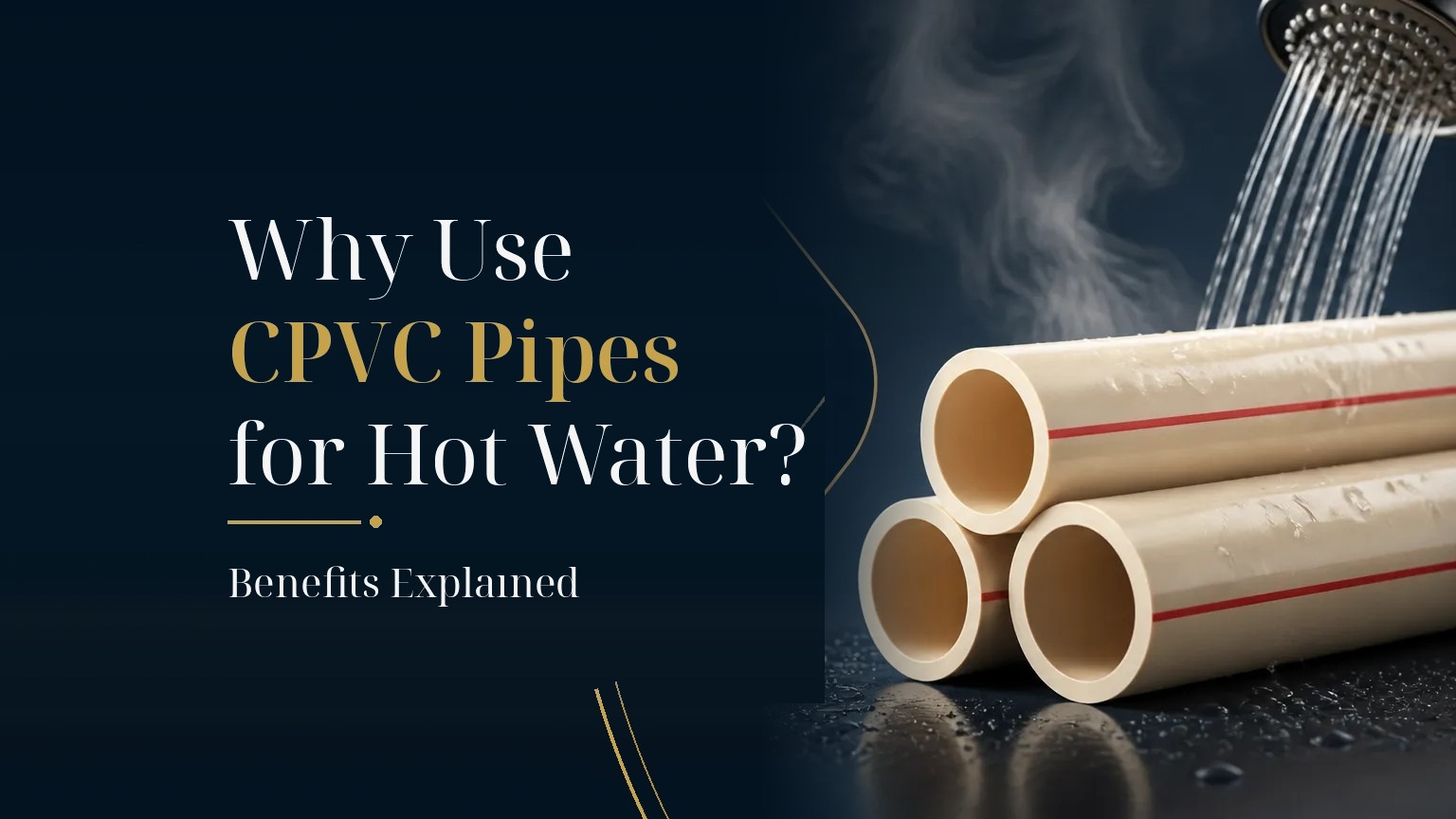
Why Use CPVC Pipes for Hot Water? Benefits Explained | Austro Pipes
Overview
Choosing the right pipe for hot water supply is a decision most Indian homeowners, builders, and plumbers make only once every few decades — yet the wrong choice leads to leaks, rust-coloured water, and costly re-piping within a few years. That is exactly why use CPVC pipes for hot water has become one of the most searched plumbing questions in India today. CPVC, or chlorinated polyvinyl chloride, is engineered specifically to handle continuous hot-water temperatures that would soften or corrode ordinary PVC, GI, and even some metal alternatives. In this guide, you will learn the science behind CPVC’s 93°C rating, how it compares with copper, GI, PPR, and PEX, what the IS 15778 standard guarantees, and how to choose the right brand for geysers, solar heaters, and multi-storey buildings in 2026.
TL;DR / Quick Answer
CPVC pipes are the most reliable, corrosion-proof, and cost-effective solution for hot water distribution in Indian homes because they are pressure-rated for continuous use up to 93°C (200°F) — well above typical geyser and solar heater setpoints of 60–75°C. They last 50+ years, do not rust or scale, install faster than copper, and meet the IS 15778 quality standard, making them the preferred choice for residential, commercial, and industrial hot-water plumbing in 2026.
What is CPVC Pipe and Why It Works for Hot Water
CPVC (chlorinated polyvinyl chloride) is a thermoplastic pipe material produced by chlorinating standard PVC resin. The chlorination process raises its service temperature ceiling from roughly 60°C to 93°C while preserving the corrosion resistance of plastic. The extra chlorine atoms bonded into the polymer backbone create a denser molecular structure that resists deformation and chemical attack far better than uPVC or ordinary PVC. In modern Indian construction, CPVC has become the default specification for geyser risers, solar heater lines, and multi-storey hot-water distribution because it does not rust, pit, or scale, and does not react with hard water or chlorinated municipal supply.
Manufacturers such as Austro Pipes – PVC Pipe Manufacturer in Hyderabad produce certified CPVC lines alongside their broader UPVC Pipes and Fittings catalogue, giving builders a single-source plumbing system for both hot and cold lines. CPVC also weighs roughly one-sixth of copper, transports in coils without kinking, and cuts cleanly with a basic pipe cutter — handling advantages that, combined with solvent-cement joining, explain why most certified Indian plumbers reach for CPVC whenever a geyser, solar water heater, or multi-storey riser enters the project scope.
CPVC Temperature Rating: Why 93°C Matters for Indian Geysers and Solar Heaters
The single most important number in any CPVC specification sheet is 93°C (200°F). According to the Plastics Pipe Institute’s Technical Note TN-62 (revised February 2026), CPVC piping systems are pressure-rated for continuous operation up to 200°F, with SDR-11 tubing rated at 400 psi at 73°F and 100 psi at 180°F. That ceiling sits comfortably above the working temperature of every common hot-water source used in Indian homes today — Indian storage geysers typically deliver 60–75°C, instantaneous gas geysers peak around 80°C, and flat-plate solar water heaters can reach 90°C on a hot summer afternoon.
The same TN-62 document confirms CPVC is suitable for thermal-disinfection cycles at 160°F (70°C) or higher — the protocol hospitals, hotels, and large commercial buildings use to control Legionella, a duty ordinary PVC and PPR cannot safely support. For homeowners comparing CPVC Pipes for Hot Water with cheaper PVC alternatives, the 93°C ceiling is the deciding factor. PVC begins to deform around 60°C, making it unsafe for any line connected directly to a geyser, heat pump, or solar heater. When buying, always check the pipe marking for the pressure class (SDR-11 for residential hot water is the most common Indian specification) and confirm the manufacturer publishes an IS 15778 or ASTM D2846 reference on the datasheet.
CPVC vs GI vs Copper vs PPR vs PEX — Detailed Hot Water Comparison
Indian plumbers traditionally compare five materials when specifying hot-water pipework: GI (galvanised iron), copper, PPR (polypropylene random copolymer), PEX (cross-linked polyethylene), and CPVC. Each behaves differently under heat, water quality, and site conditions. GI was once the default, but it rusts from the inside out, scales up within a few years, and releases iron particles that stain fixtures and encourage bacterial growth. Copper is durable and heat-tolerant but expensive, prone to theft at site, and loses more standby heat than plastic alternatives. PPR is excellent for cold and warm water but softens above 70°C, while PEX needs special crimp tools and imported fittings that are harder to source in tier-2 Indian markets.
CPVC combines the strengths of all four without the headline weaknesses. It carries a 93°C continuous rating, typically costs less than copper per installed metre, joins with a basic solvent-cement kit, and is widely available across India. IS 15778 is the Indian standard written specifically for CPVC hot- and cold-water distribution, with ASTM D2846 as its international counterpart. For projects that mix hot and cold lines, builders often pair CPVC hot runs with UPVC Pipes and Fittings for the cold side to optimise cost without compromising performance.
Quick Comparison Snapshot
| Pipe Material | Max Continuous Temp | Typical Service Life | Corrosion Risk | Relative Cost | IS 15778 Standard |
|---|---|---|---|---|---|
| GI (Galvanised Iron) | ~70°C | 10–15 years | High | Low | No |
| Copper | 200°C+ | 50+ years | Low (pitting possible) | High | N/A |
| PPR | ~70°C | 50 years | None | Medium | No |
| PEX | ~95°C | 50 years | None | Medium-High | No |
| CPVC | 93°C | 50+ years | None | Medium | Yes |
IS 15778 Standard: How to Verify Genuine CPVC Pipes in India
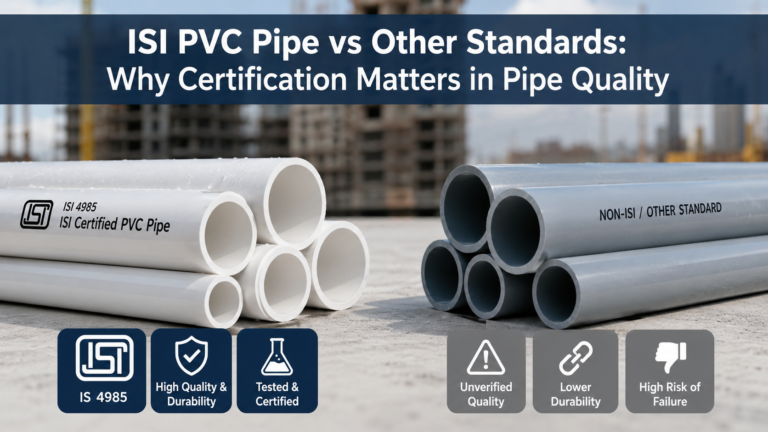
IS 15778 is the Bureau of Indian Standard specification that governs chlorinated polyvinyl chloride pipes and fittings for hot and cold water supply in India. Any CPVC pipe carrying the ISI mark and the IS 15778 designation has passed pressure-cycle, heat-resistance, and chemical-resistance tests set by BIS, and is the only CPVC product considered code-compliant for residential and commercial hot-water plumbing in the country. To verify a brand’s authenticity, look for four markings on the pipe itself: the ISI logo, the IS 15778:2007 (or latest amendment) code, the manufacturer’s name or trademark, and the nominal size plus SDR class.
The same pipe should be accompanied by a test certificate from the manufacturer’s in-house lab, and reputable brands publish their BIS licence number on the website. Internationally, ASTM D2846 covers the equivalent specification for CPVC hot- and cold-water distribution, and quality Indian manufacturers — including Austro Plastic Industries LLP, an ISO 9001:2015-certified producer headquartered in Hyderabad — align their CPVC range with both IS 15778 and ASTM D2846 testing protocols. Avoid unbranded or grey-market CPVC, even when it looks cheaper; without IS 15778 testing, the pipe may have inconsistent wall thickness, recycled resin content, or incorrect pressure ratings.
Energy Efficiency: How CPVC Cuts Heat Loss and Electricity Bills
Every metre of uninsulated hot-water pipe loses heat to the surrounding air. In a typical Indian home with a 6–10 metre geyser-to-bathroom run, that standby loss adds to annual water-heating electricity costs. The lower the pipe’s thermal conductivity, the smaller the loss — and that is where CPVC pulls decisively ahead of copper and GI. A 2010 NAHB Research Center study, still cited as the industry benchmark, found that plastic piping materials — including CPVC — reduce hot-water pipe heat losses by about 25% compared with metal pipe materials.
The thermal conductivity of plastic piping is far lower than that of metallic piping, so bare CPVC loses less heat than bare copper at the same service temperature. For multi-storey buildings and hotels with recirculation loops, the savings compound because hot water is maintained at temperature around the clock. Adding basic 9-mm foam insulation around CPVC runs drops the heat-loss coefficient further, and IS 15778-compliant CPVC accepts standard closed-cell pipe insulation without chemical compatibility issues — a benefit copper and GI systems cannot always claim. Over a 30-year service life, the cumulative energy saved typically offsets a meaningful slice of the original plumbing budget on its own.
Installation Guide: Solvent Cement Joining, Curing Time and Common Mistakes
CPVC installation uses cold chemical welding — no heat, no flame, no electricity. A purpose-made CPVC primer and solvent cement soften the outer pipe wall and inner fitting socket; the parts are pushed together, and the solvent evaporates to form a homogeneous, leak-proof joint that is chemically identical to the pipe itself. The recommended sequence is straightforward: cut the pipe square with a wheel cutter or fine-tooth saw, deburr the end, dry-fit the joint and mark insertion depth, apply CPVC primer to both surfaces, immediately brush a uniform coat of CPVC solvent cement, push the pipe into the fitting with a quarter-turn twist, and hold for 30 seconds.
Cure times vary with pipe size and ambient temperature — typically 15 minutes for non-pressure testing on 1/2-inch lines and 24 hours before full-pressure testing on 1-inch and above. Never substitute PVC cement for CPVC cement, because the solvent formulation differs and the joint will fail under hot water. Common field mistakes include skipping the primer, rotating the joint after initial set, using excessive cement, and pressure-testing too early. Printable procedures are published in the Austro Pipes Blog — for concealed risers in walls and chases, always pressure-test the line before closing the surface.
Buying Guide: Choosing a Certified CPVC Brand in India
The Indian CPVC market in 2026 is led by a mix of national manufacturers and strong regional players. Widely specified national brands include Astral, FlowGuard (Lubrizol-licensed), Supreme, Prince, and Finolex, while regional producers such as Austro Pipes, Jindal, and Prayag serve strong local dealer networks in Telangana, Andhra Pradesh, Tamil Nadu, and the northern states. Each of these brands publishes IS 15778 certification, offers the full SDR-11 and SDR-13.5 size range, and supports both 1/2-inch domestic and 2-inch commercial hot-water lines.
Rather than chasing the lowest sticker price, evaluate three things before buying. First, confirm the BIS licence number and ISI mark on every coil. Second, check the manufacturer’s after-sales support — branded CPVC typically carries a 50-year rated service life when installed to spec. Third, compare total installed cost (pipe + fittings + cement + labour), not just per-metre pipe price, because cheaper non-branded pipe often pushes up labour and fitting costs. Fixed prices fluctuate with resin markets and regional taxes, so request a fresh quote from your dealer or use the brand’s official enquiry channel — for example, Get a Quote for CPVC Pipes from Austro — and confirm the rate in writing. Browse the full Austro Pipes product range to compare CPVC with UPVC, SWR, and casing-and-capping options in one place.
Applications: Geysers, Solar Water Heaters, Multi-storey and Industrial Hot Water
CPVC’s combination of 93°C heat tolerance, corrosion resistance, and solvent-cement jointing makes it suitable for almost every hot-water application in modern Indian construction. In individual homes, it is the default specification for the 2–6 metre riser between a storage geyser and the bathroom fixture, for kitchen-boiler feeds, and for the cold-water inlet that mixes with solar-heated output to deliver safe tap temperature. In multi-storey residential towers, CPVC handles vertical hot-water risers in tall multi-storey buildings when correctly supported and pressure-rated.
Hotels, hospitals, and commercial kitchens rely on CPVC for continuous recirculation loops because the material tolerates the constant 60–70°C operating temperature and the periodic thermal-disinfection cycles (71°C+) used to control Legionella. Industrial users deploy CPVC for process-water lines in food and beverage, pharmaceutical, and textile plants where hot-water wash-down is routine and metal contamination must be avoided. When specifying CPVC Pipes for Geysers and Solar Heaters, match the pipe class to the job: SDR-11 for standard residential hot water, SDR-13.5 for warm-water distribution, and heavier Schedule 80 equivalent for industrial high-pressure service.
Maintenance, Lifespan (50+ Years) and Warranty Claims
A correctly installed CPVC hot-water system has a rated service life of 50 years or more, with virtually no routine maintenance beyond what any plumbing system requires. Because CPVC does not rust, scale, or pit, the inner diameter stays constant for decades — which is why multi-decade service-life ratings from leading manufacturers are now standard across the Indian market. Annual maintenance is limited to inspecting visible joints for signs of weeping, exercising isolation valves, and checking that expansion clips and pipe brackets remain tight, particularly on vertical multi-storey risers where thermal expansion is significant.
The most common warranty-trigger situations in India involve unbranded CPVC, improper solvent-cement technique, and concealed leaks discovered after builder handover. To protect warranty rights, retain three documents: the original purchase invoice with batch numbers, the installer’s pressure-test report, and the manufacturer’s test certificate. Photograph concealed joints before plastering or tiling, and never paint the pipe with solvent-based coatings that can chemically attack CPVC. For long-term peace of mind, choose manufacturers that publish long-lasting CPVC pipe systems backed by documented IS 15778 compliance, ISO 9001:2015 quality management, and a responsive regional distributor.
FAQs on CPVC Pipes for Hot Water
What is CPVC and why is it used for hot water?
CPVC (chlorinated polyvinyl chloride) is a chlorinated thermoplastic pipe material rated for continuous hot-water service up to 93°C. Its heat tolerance, corrosion-proof inner surface, and 50+ year service life make it the default specification for geyser, solar heater, and commercial recirculation lines in modern Indian plumbing.
What is the maximum temperature CPVC pipes can handle?
CPVC is pressure-rated for continuous use up to 93°C (200°F) per PPI TN-62 (2026), with short excursions tolerated slightly higher. This ceiling sits well above Indian geyser setpoints of 60–75°C and flat-plate solar outputs of 80–90°C.
Is CPVC safe for drinking water?
Yes. IS 15778-compliant CPVC does not leach heavy metals, supports bacterial growth resistance compared with metal pipes, and is specified by IS 15778 for potable hot- and cold-water distribution supplies.
Can CPVC pipes be used for solar water heater connections?
Yes. CPVC handles the high-temperature output of flat-plate and evacuated-tube solar collectors safely, and most leading Indian manufacturers explicitly recommend CPVC for both solar-to-geyser and solar-to-tap distribution lines.
How long do CPVC pipes last?
Correctly installed CPVC hot-water systems carry a rated service life of 50+ years, supported by IS 15778 testing, ASTM D2846 compliance, and ISO 9001:2015 manufacturing controls maintained by reputable producers.
Where can I buy certified CPVC pipes in India?
Certified CPVC is available through authorised dealers of national brands (Astral, Supreme, FlowGuard, Prince) and regional manufacturers. For product specifications, IS 15778 documentation, and dealer enquiries, Contact Austro Pipes directly or use the Get A Quote form on the brand website.
Conclusion
The question of why use CPVC pipes for hot water has a clear answer: CPVC is the only plastic pipe with IS 15778 certification that combines a 93°C continuous rating, corrosion-proof performance, 50+ year service life, and lower total installed cost than copper. It installs faster than PEX, outlasts GI, and outperforms PPR on high-temperature duty cycles — the most balanced choice for geysers, solar heaters, multi-storey risers, and commercial hot-water systems in 2026.
For builders, dealers, and homeowners planning a new project, shortlist two or three IS 15778-certified brands, request fresh quotations, and verify the BIS licence before placing a bulk order. For reliable CPVC supply across Telangana, Andhra Pradesh, and pan-India enquiries, Contact Austro Pipes to discuss specifications, dealer terms, and dispatch timelines.