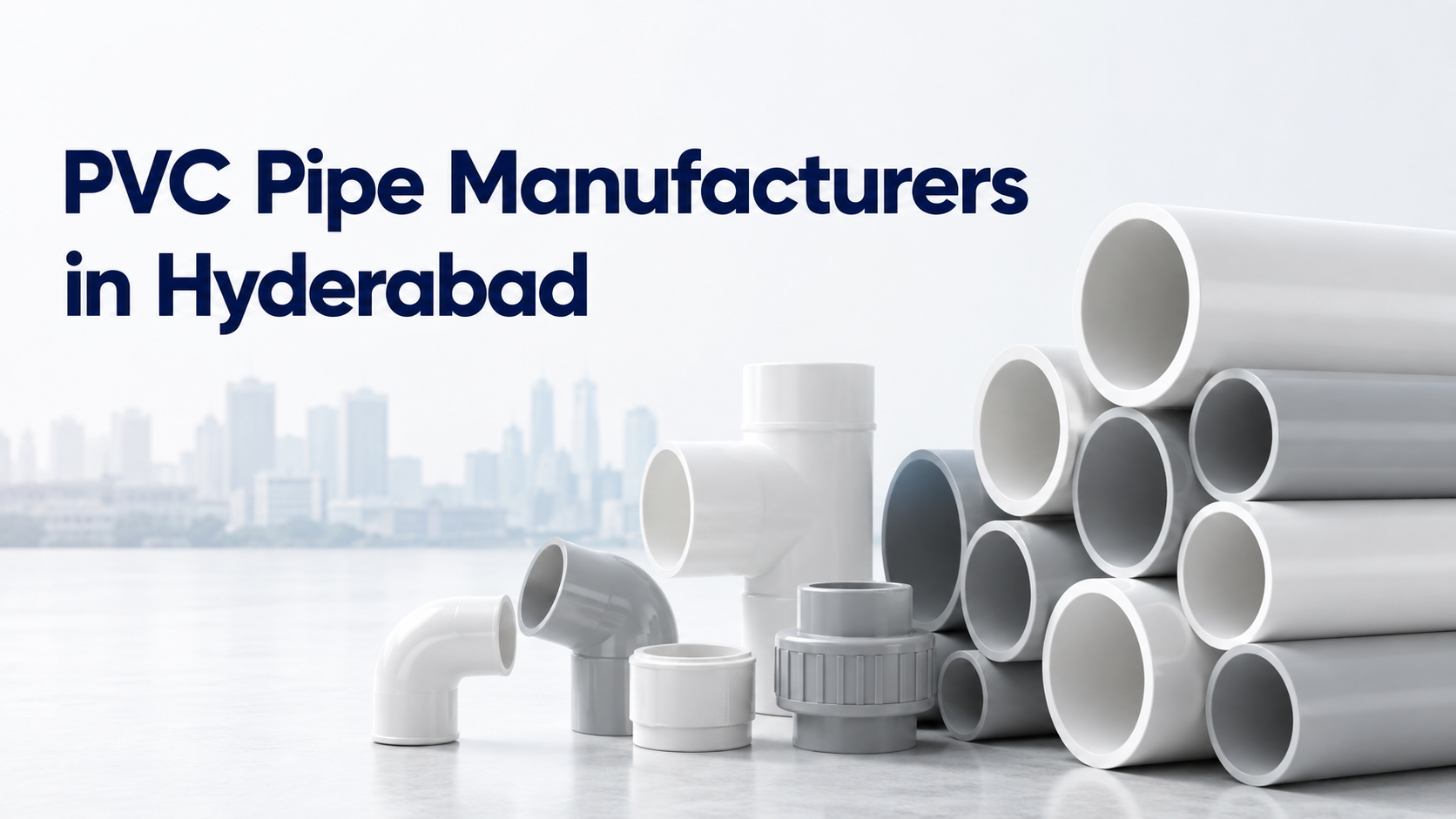
PVC Pipe Manufacturers in Hyderabad: How Contractors Can Source SWR Pipes and Fittings
For contractors working on residential, commercial, and infrastructure projects, choosing dependable PVC pipe manufacturers in Hyderabad is an important part of planning a reliable drainage system. SWR (Soil, Waste and Rainwater) pipes are commonly used for applications such as wastewater discharge, ventilation, and rainwater management inside and outside buildings.
However, sourcing SWR pipes is not simply about comparing prices. Contractors also need to evaluate pipe dimensions, fittings compatibility, applicable Indian Standards, jointing requirements, product consistency, availability, and supplier support. For businesses exploring related manufacturing capabilities, understanding the expertise of PVC pipe machine manufacturers in Hyderabad can also be useful when evaluating production quality and consistency.
This guide explains what contractors should check when sourcing SWR pipes and fittings, how to evaluate manufacturers, and how to avoid common procurement problems.
Call us at: +91 99495 04930
What Are SWR Pipes and Fittings?
SWR pipes are PVC-U piping products designed for soil, waste discharge, ventilation, and rainwater systems. The applicable Indian Standard for PVC-U pipes used in these systems is IS 13592:2013, while injection-moulded PVC-U fittings are covered under IS 14735:1999.
An SWR system normally includes:
- Straight pipes
- Bends
- Tees and wyes
- Couplers and sockets
- Reducers
- Traps
- Adaptors
- Cleansing pipes
- Vent cowls
- Pipe clips
These components work together to create a continuous drainage and waste-discharge network. Selecting pipes and fittings designed to work together helps contractors reduce installation problems and achieve properly connected joints.
Why Should Contractors Carefully Choose PVC Pipe Manufacturers in Hyderabad?
The manufacturer has a direct influence on product consistency, dimensional accuracy, availability, and technical support. A contractor may purchase an apparently low-cost pipe, but poor dimensional consistency or incompatible fittings can create additional labour and maintenance problems during installation.
A reliable supplier should be able to provide clear product information, applicable standards, sizes, fitting options, and documentation.
When evaluating PVC pipe manufacturers Hyderabad, contractors should consider:
- Applicable standards – Check whether the relevant pipe and fitting specifications correspond to the intended application.
- Product range – Confirm that required pipe sizes and fittings are available together.
- Dimensional consistency – Pipes and fittings should be compatible for proper jointing.
- Material and manufacturing quality – Ask about product specifications and quality-control procedures.
- Availability – Consistent supply matters when projects involve multiple construction stages.
- Technical support – A manufacturer that can clarify product selection and installation requirements can make procurement easier.
The Bureau of Indian Standards lists IS 13592:2013 for PVC-U pipes used in soil and waste discharge systems, including ventilation and rainwater systems.
What Should Contractors Check Before Buying SWR Pipes?
Before placing a bulk order, contractors should verify several technical and commercial factors.
1. Check the Application
First identify where the piping will be installed. Internal soil and waste discharge, external drainage, ventilation, and rainwater applications may have different design considerations.
The pipe should be selected according to the project’s drainage design rather than simply choosing a commonly available size.
2. Verify Applicable Standards
Standards provide a useful benchmark when evaluating products. For example, BIS identifies IS 13592:2013 for PVC-U pipes used in soil and waste discharge systems, including ventilation and rainwater systems.
For injection-moulded UPVC fittings used with these systems, IS 14735:1999 covers requirements including dimensions, workmanship, mechanical properties, and joint-related performance. UPVC pipe fittings manufacturers should ensure their products meet applicable standards and maintain consistent quality to support reliable installation and long-term system performance.
Contractors should verify the current applicable specification and product certification details rather than relying only on a manufacturer’s marketing description.
3. Match Pipes With Compatible Fittings
A drainage system requires more than straight pipe lengths. Contractors may need bends, tees, reducers, couplers, traps, adaptors, and other components. A reliable CPVC pipe company in India typically offers compatible fittings and accessories as part of its product range, making it easier for contractors to source the required components from a consistent manufacturer.
Using fittings from a compatible product range can simplify installation and reduce the possibility of mismatched dimensions or jointing arrangements.
4. Inspect Product Markings and Documentation
Before accepting a bulk shipment, check product markings, dimensions, applicable standard references, packaging, and documentation supplied with the material.
For larger projects, procurement teams should maintain records of product specifications and inspection details so that materials can be traced back to the approved supplier.
How to Source SWR Pipes From a Reliable Manufacturer
A systematic procurement process can help contractors compare suppliers more objectively.
Step 1: Prepare a Material Requirement
Create a list containing:
- Pipe sizes
- Required quantities
- Fitting types
- Project location
- Delivery schedule
- Intended application
- Required standard/specification
- Installation requirements
This prevents suppliers from quoting against incomplete requirements.
Step 2: Shortlist Suitable Manufacturers
Search for established PVC pipe manufacturers in Hyderabad and compare their product range, technical documentation, manufacturing capabilities, and supply capacity.
For projects involving significant quantities, contractors should also determine whether the supplier can maintain consistent supply throughout the construction schedule.
Step 3: Compare Technical Specifications
Do not compare quotations only on price. Review pipe dimensions, fitting compatibility, applicable standards, product type, and available sizes.
A slightly different product specification can affect installation, so technical comparison should come before commercial comparison.
Step 4: Evaluate Fitting Availability
Ask whether the manufacturer can supply the complete SWR system, including the fittings required for the project.
A supplier that provides both pipes and compatible fittings can simplify procurement and reduce coordination between multiple vendors.
Step 5: Review the Commercial Offer
Once the technical requirements are confirmed, compare:
- Unit pricing
- Minimum order quantity
- Transportation costs
- Delivery timeline
- Payment terms
- Replacement policy
- Availability of stock
- Bulk-order support
This provides a more realistic picture of the total procurement cost.
What Fittings Are Commonly Required for SWR Systems?
The right fitting depends on the drainage layout and connection requirements. BIS documentation for IS 14735 identifies fittings such as tees, wyes, bends, reducers, couplers, socket plugs, cleansing pipes, adaptors, vent cowls, pipe clips, and waste traps with strainers.
Some commonly used components include:
| Fitting | Typical purpose |
| Bend | Changes the direction of the pipeline |
| Tee | Creates a branch connection |
| Wye | Provides an angled branch connection |
| Coupler | Joins compatible pipe sections |
| Reducer | Connects different pipe sizes |
| Trap | Helps manage waste connections and odour control |
| Adaptor | Connects different piping arrangements |
| Cleansing pipe | Provides access for cleaning and maintenance |
The exact combination should always follow the project’s plumbing and drainage design.
Common Procurement Mistakes Contractors Should Avoid
Even when a manufacturer appears suitable, procurement mistakes can cause delays or installation issues.
Choosing Only on Price
The lowest quotation does not necessarily provide the lowest overall project cost. Product compatibility, delivery reliability, wastage, installation time, and replacement requirements can all affect the final cost.
Ordering Pipes Without Fittings
Ordering straight pipes first and arranging fittings later can create compatibility and availability problems. Prepare the complete material schedule before placing the order.
Ignoring Project-Specific Requirements
Different buildings can have different drainage layouts and requirements. Product selection should be based on the approved plumbing design rather than a generic material list.
Failing to Inspect Deliveries
Bulk material should be checked when received. Look for visible damage, incorrect sizes, missing components, and discrepancies between the purchase order and delivered products.
Mixing Incompatible Product Ranges
Using pipes and fittings without confirming dimensional or joint compatibility can create installation difficulties. Contractors should verify compatibility before combining products from different sources.
How Do Pipe Fittings Manufacturers in India Support Large Projects?
Established pipe fittings manufacturers in India can support contractors by offering a broader range of components and maintaining consistent product specifications across orders.
For large construction projects, this can be particularly useful because contractors may require multiple fittings in different configurations and sizes. Working with an experienced pipe fittings manufacturer can also simplify communication when technical clarification or repeat orders are required.
The key consideration is not simply the number of products available. Contractors should evaluate whether the manufacturer’s fittings meet the relevant application requirements and work properly with the selected pipe system.
Why Product Quality Matters for Hyderabad Construction Projects
Hyderabad’s expanding residential, commercial, and institutional construction activity creates demand for dependable drainage solutions. For contractors, the practical challenge is ensuring that the selected materials remain suitable from procurement through installation.
A good SWR piping system should be supported by:
- Correct product selection
- Appropriate pipe and fitting dimensions
- Proper jointing
- Suitable installation practices
- Quality inspection
- Reliable material availability
- Clear technical documentation
BIS’s current standards resources provide access to Indian Standards, amendments, certification information, and related technical documents, making them useful for verifying applicable requirements.
How Can Contractors Choose the Right Supplier?
The best supplier is not necessarily the one offering the lowest initial quotation. A more practical evaluation should consider quality, compliance, range, supply reliability, and project support together.
Before finalizing a supplier, ask:
- Does the product meet the applicable Indian Standard?
- Are the required pipe sizes available?
- Are compatible fittings available?
- Can the supplier handle the required quantity?
- Are technical specifications clearly documented?
- What is the expected delivery schedule?
- How are damaged or incorrect materials handled?
- Can the supplier support repeat or phased orders?
A supplier that can answer these questions clearly is easier to evaluate and manage during a construction project.
Conclusion
Selecting the right SWR piping system requires more than finding a supplier with competitive prices. Contractors should evaluate product specifications, applicable Indian Standards, fitting compatibility, quality controls, availability, documentation, and delivery capability before placing an order.
For construction projects, working with dependable PVC pipe manufacturers in Hyderabad can make material planning and procurement more predictable. AustroPipes can be considered as part of a structured supplier evaluation, with contractors focusing on the product specifications and requirements relevant to their project.
For the best results, prepare a complete pipe-and-fitting schedule, verify the applicable standards, compare suppliers on technical and commercial factors, and inspect materials before installation.
Need Reliable SWR Pipes and Fittings for Your Project?
Choosing the right piping products can help contractors maintain efficient drainage installations and avoid unnecessary procurement issues. AustroPipes offers PVC pipes and fittings for different project requirements. For product details, availability, or assistance with your requirements, get in touch with the team today.
Call us at: +91 99495 04930
Email: info@austropipes.com
Frequently Asked Questions
What are SWR pipes used for?
SWR pipes are primarily used for soil and waste discharge, ventilation, and rainwater systems in and around buildings. The appropriate pipe should be selected according to the application, drainage design, dimensions, and applicable product standard.
What standard applies to PVC-U SWR pipes in India?
IS 13592:2013 covers PVC-U pipes for soil and waste discharge systems inside and outside buildings, including ventilation and rainwater systems. Contractors should verify the current applicable requirements and certification information before procurement.
What standard covers SWR pipe fittings?
IS 14735:1999 covers injection-moulded UPVC fittings for soil and waste discharge systems, including ventilation and rainwater applications. It includes requirements covering different fitting types, dimensions, workmanship, mechanical properties, and joint performance.
How should contractors compare SWR pipe suppliers?
Compare suppliers on applicable standards, product range, dimensional consistency, fitting availability, documentation, delivery capability, technical support, and commercial terms. Price should be evaluated alongside these factors rather than used as the only selection criterion.
Can pipes and fittings from different manufacturers be used together?
They may be compatible in some situations, but compatibility should be verified before installation. Differences in dimensions, socket design, jointing method, or product specifications can create installation problems. Using a coordinated pipe and fitting range can make procurement and installation simpler.
What should be checked when receiving SWR pipes?
Check the delivered quantity, pipe sizes, fitting types, visible damage, product markings, packaging, and documentation. Compare the shipment against the purchase order and approved material specifications before moving the material into installation.
How can contractors reduce SWR material procurement problems?
Start with a detailed material schedule, select products according to the drainage design, verify applicable standards, confirm pipe-and-fitting compatibility, and inspect deliveries. Planning the complete requirement before ordering can reduce shortages, mismatched components, and avoidable delays.